
After a stroke, your ability to taste and smell may change. These pages can help you understand why this happens and how to get help if you need it. There are also practical tips for stroke survivors, family and friends.
My tastebuds are different. I can eat things I could not before, yet dislike some things I loved to eat. My sense of taste is heightened, very strong and bitter is now more noticeable
Karen, stroke survivor
On this page:
What is taste and smell?
Other sensations from food
What are the types of change to taste and smell?
Support
Accessible resources
What is taste and smell?
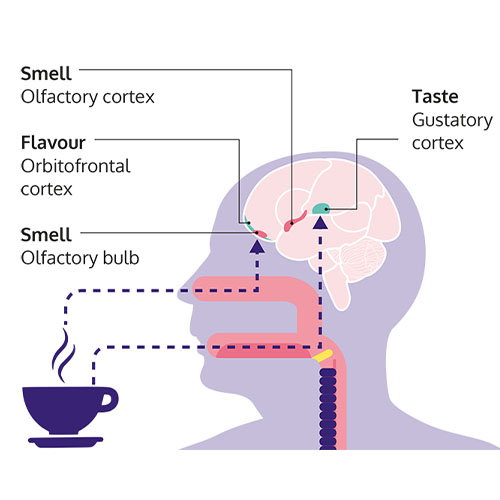
The senses of taste and smell work together. Your tongue can detect five basic tastes (salty, sweet, bitter, sour and ‘umami’ or savoury). Flavour is different from taste, because it depends mainly on your sense of smell. That’s why food has less flavour when you have a blocked nose.
This is how your nose, tongue and brain work together to detect smells, tastes and flavours:
- When something gives off a smell, such as coffee, it means millions of smell molecules are rising from the coffee into the air. When you breathe, the molecules hit the smell receptor cells at the back of your nose. Taste works in the same way. When you eat or drink, molecules hit the taste receptors on your tongue.
- The taste and smell receptors send information through nerves into the brain. The brain interprets the information as smells and tastes.
- Inside the brain, taste and smell information are combined to let you detect and identify flavours.
- Areas of the brain dealing with memory, learning and emotion are also involved in taste and smell. So smells and tastes can be linked to feelings and memories.
Other sensations from food
The nose and tongue are part of our chemosensory system. This system allows us to understand the world through molecules (chemicals) that come from the objects and materials around us. As well as taste and smell, we have other chemosensory responses that give different sensations from food, such as heat from chilli peppers and coolness of mint. Receptors in your mouth help you detect food textures such as crunchy or smooth.
Always get individual advice
These pages contain general information about stroke. But if you have a problem, you should get individual advice from a professional such as a GP or pharmacist. Our Helpline can also help you find support. We work very hard to give you the latest facts, but some things change. We don’t control the information provided by other organisations or websites.
What are the types of change to taste and smell?
Taste changes
There are different types of problem with taste, including:
- Ageusia: not being able to taste anything.
- Burning mouth syndrome: a burning or scalding sensation most often affecting the tongue. It can happen alongside other types of taste change.
- Dysgeusia (also known as parageusia): food and drink has a distorted taste. For example, something might taste bitter or metallic.
- Hypogeusia: a reduced ability to taste, so things can taste bland.
- Phantogeusia: having a taste in your mouth when you’re not eating or drinking. This could be any taste from metallic to sweet.
Smell changes
There are different types of smell problems, including:
- Anosmia: being unable to smell anything.
- Dysosmia – a distorted sense of smell. This has two forms:
- Parosmia (also called troposmia): smells are distorted. They can seem different or unpleasant.
- Phantosmia: smelling something that is not there.
- Hyperosmia: being oversensitive to smell.
- Hyposmia: a reduced ability to smell.
Support
Our Stroke Support Helpline is for anyone affected by a stroke, including family, friends and carers. The Helpline can give you information and support on any aspect of stroke.
Call us on 0303 3033 100, from a textphone 18001 0303 3033 100 or email helpline@stroke.org.uk
Other sources and help and information
SmellTaste is a charity that provides support and information on taste and smell disorders.
Resources
The information on this page can be accessed in other formats:
- Download this guide in
- Order a printed copy from our shop.
- To request a braille copy email feedback@stroke.org.uk