
Swallowing problems are very common after a stroke and are also known as dysphagia. The information on this page explains some causes of swallowing problems and how they are treated, as well as tips for living with swallowing problems.
On this page:
What causes swallowing problems?
The four stages of swallowing
Signs of swallowing problems
Can swallowing problems make you unwell?
Are there treatments for swallowing problems?
Swallowing assessments
Tube feeding
Tips for living with swallowing problems
Tips for family and friends
What causes swallowing problems?
Swallowing is a complicated task that needs your brain to coordinate many different muscles in the mouth and throat. If your stroke damages the parts of your brain that do this, then this will affect your ability to swallow.
Other effects of stroke can make eating, drinking and swallowing difficult too. If your arm or hand has been affected by your stroke, you may not be able to use a spoon or a cup properly. This can affect the way you swallow. If your face or lip muscles are affected, you might find that saliva (spit) escapes from your mouth.
If your balance has been affected, you may not be able to sit up straight, which can make swallowing more difficult. If you’re drowsy or not able to concentrate very well, then you may not swallow your food in the right way.
This aphasia friendly video provides information on eating and drinking after stroke. To return to the aphasia friendly information page click here.
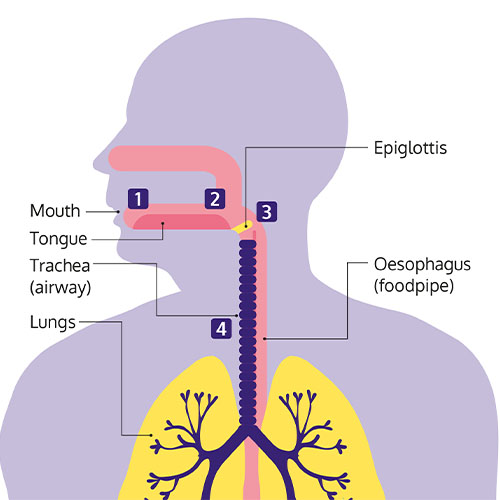
The four stages of swallowing
- There are several stages to swallowing. A stroke can affect any one of these stages.
- You see and smell food and put it in your mouth. You then prepare it for swallowing by mixing with saliva, chewing and moving it around your mouth.
- You close your lips and your tongue moves the food or drink to the back of your mouth.
- The food or drink moves through your throat to your food pipe (oesophagus), which carries food to your stomach. At the point of swallowing, a flap in your throat (the epiglottis) moves to close over and protect your airway (trachea). This stops any food from going into your lungs.
- The muscles in your oesophagus squeeze in waves from top to bottom, moving the food down into your stomach. This is known as peristalsis.
Signs of swallowing problems
Swallowing problems are not always obvious, so it’s good to know what to look out for. Signs of swallowing problems include:
- Coughing or choking when you’re eating or drinking.
- Bringing food back up, sometimes through your nose.
- Food or drink going down the wrong way.
- Feeling that food is stuck in your throat.
- Not being able to keep food or drink in your mouth.
- Still having food or drink left in your mouth after you’ve swallowed.
- Not being able to chew food properly.
- A croaky or ‘wet’ sounding voice.
- Saliva escaping from your mouth.
- Taking a long time to swallow or finish a meal.
- Having to swallow a lot to clear your throat, or loudly clearing your throat.
- Being short of breath when you’re swallowing.
Can swallowing problems make you unwell?
If you have difficulty swallowing, food and drink may be getting into your airway and lungs. Even saliva (spit) can enter the airway if someone is not able to swallow properly, or if they are drowsy and cannot cough normally. This is called aspiration.
Aspiration can be very serious. Your mouth contains high numbers of bacteria (germs) and if these enter the airway, it can lead to pneumonia, a serious infection in the lungs. So it’s extremely important any change to your swallowing is spotted early, to avoid this happening.
Your stroke team will watch carefully for any signs of aspiration and pneumonia. Everyone who has a stroke should have their swallowing assessed within four hours of arriving at hospital. You should not swallow any food, drink or medicine until your swallowing has been checked.
Signs of complications due to swallowing problems
After a stroke, your risk of pneumonia is higher. Some of the main signs of pneumonia may include:
- High temperature, aches and pains.
- Feeling generally unwell.
- Feeling the need to cough.
- Difficulty breathing such as feeling out of breath, or rapid, shallow breathing.
- Chest pain.
- Feeling confused.
There are other signs of pneumonia, so check with a health professional or contact 111 if you notice any symptoms of infection. If someone is struggling to breathe or has chest pain or a rapid heartbeat, call 999.
See the NHS website for more information about pneumonia, including a list of symptoms and advice on when to seek help.
Over time, swallowing problems can lead to you losing weight, or not getting enough nutrients from your diet. If you weigh less than usual, or you notice your clothes getting looser, speak to your dietitian, speech and language therapist or stroke nurse. If you do not have a therapist, contact your GP.
You need to get enough energy (calories) and nutrients from your food, to help your body and brain recover after a stroke. It’s likely that your stroke team will have a dietitian who can help you with any changes to your diet.
They can monitor your weight and how much you’re eating and drinking, to make sure that you stay healthy. If they’re worried that you’re not getting everything you need, they may suggest that you take supplements or try special foods to boost your diet.
Are there treatments for swallowing problems?
Swallowing problems can get better and most people are able to swallow safely again within the first few weeks. A small number of people have problems that last longer than this. Only a very small number of people are left with lasting difficulties.
Even if you are left with permanent difficulties, they do not have to stop you from doing what you want to do. Most people find they’re still able to live full lives. But it may take some time to adjust to the changes that you need to make.
If you have problems with swallowing, you should be referred to a speech and language therapist, who will work with you to try to improve them. Your speech and language therapist will complete an assessment with you, to work out exactly what’s going on. Once they know this, they’ll be able to talk to you and your family about the best ways to treat or manage your swallowing difficulties.
To begin with, the most important thing will be making sure that you can swallow safely. Your speech and language therapist will explain the different things you can do. This could include:
- Changing how you eat and drink.
- Learning techniques that can help you to swallow.
- Using aids that can help you to eat or drink more easily.
As well as these, your speech and language therapist may also get you to practise exercises to strengthen muscles in your throat, face and mouth. This may help you to swallow better and protect your airway.
Colt, stroke survivor
Changing how you eat and drink
If you cannot swallow safely, then you’ll probably need to make changes to your diet with advice from a speech and language therapist.
Drinking safely
It’s important to drink enough, because your body needs to stay hydrated to fight off infections and help you recover from stroke. Water and other thin liquids are the hardest things to swallow because they’re difficult to control once they enter your mouth. Your therapist might assess you and discuss if using thickened drinks may be of benefit to you. These can be made using special powders to create the right level of thickness.
To make thicker liquids more enjoyable to drink, you might be able to try chilled or flavoured drinks. Making sure the drink is freshly prepared, and not thicker than it needs to be, could make it more pleasant to drink. Your therapist may be able to suggest how to make some regular drinks to the right consistency, such as smoothies or milkshakes.
Eating soft or pureed food
If you have problems with chewing and swallowing, you may need to eat soft food. There are different categories of food softness, from soft and bite-sized through to liquidised. A speech and language therapist can advise you on the right texture.
Change the temperature
Hot foods and drinks can be difficult to swallow because you cannot hold them in your mouth as long. Your therapist may suggest that you stick to cold foods, or allow hot food to cool down quite a bit before you try to eat it.
Change how and when you eat
Eating small amounts throughout the day, rather than three big meals, for example, may be better for you if you’re finding it hard to concentrate or you get tired very quickly. You may also find small portions are easier to manage, or that eating earlier in the day when you have more energy works better.
Your speech and language therapist will explain to you and your family exactly what foods are safe for you to eat. They’ll also make sure the rest of your stroke team are clear about what you can and cannot eat, and how you should be eating. Your stroke team should discuss any recommendations with you and involve you in making decisions.
Some people make a good recovery from swallowing problems. The way you eat, and what you are able to eat and drink, may change over time as you go through your recovery. You might be able to go back to eating more of the foods you are used to. If your swallowing problems are long-term, with good care and support, you can have a good diet and enjoy your food and drink.
Other treatments
A treatment called transcutaneous neuromuscular electrical stimulation (NMES) may be offered to some stroke survivors with dysphagia, alongside other swallowing therapies. Electrodes are placed on your skin to stimulate nerves while you swallow, to try to help strengthen the muscles involved in swallowing and help to rebuild the relevant pathways in brain. The benefits and risks of the treatment should be explained to you. However, NMES needs to be carried out by a healthcare professional who is trained to use the equipment, and currently it may not be available in every area on the NHS.
Swallowing assessments
You’ll probably have a number of swallowing assessments while you’re in hospital, to check how your swallowing improves over time.
- Your therapist will usually begin by asking you to swallow a very small amount of water, followed by food and drinks of different consistencies, to show whether you can swallow them safely.
- A videofluoroscopy involves taking video x-rays of your mouth and throat while you swallow. You will sit beside an x-ray machine and be given different foods and drinks to swallow. These will be mixed with a special liquid called barium that will show up on the x-rays.
- A fibreoptic endoscopic evaluation of swallowing (FEES) uses an endoscope to find out what’s happening when you swallow. An endoscope is a long, thin, flexible tube that has a light and a tiny camera at the end of it. It’s inserted into one of your nostrils and down your throat, so that your therapist can see how well your muscles are working and where the problems may be occurring.
You can ask for another assessment if you think your swallowing has changed. If you’re not able to swallow, you may be given fluids through a drip into a vein, to make sure that you do not become dehydrated. It’s also important you get the right nutrition, so your stroke team may also talk to you about being fed by a tube.
Tube feeding
If your swallowing problems make it hard for you to eat enough, you might lose weight and miss out on important nutrients. This can cause low energy levels and even slow down your recovery. If this happens, you might be offered tube feeding. Tube feeding means putting liquid food directly into your digestive system through a tube. This is also known as enteral feeding. You might only need it for a short time if your swallowing improves, but some people will need it for longer.
There are different types of feeding tube. The two that are used most often after a stroke are nasogastric (NG) tubes and percutaneous endoscopic gastrostomy (PEG) tubes. NG tubes go through the nose into the stomach. They tend to be temporary and are normally used if you’ll need to be tube fed for less than four weeks. A PEG tube is inserted into the stomach through a hole in your skin. They tend to be used for longer periods.
If after some time using an NG tube you are thinking of changing to a PEG, you’ll need to talk through both options with your stroke team and family, to decide which one is best for you. There are advantages and disadvantages to both. Your stroke team should discuss any benefits and risks with you.
A very thin tube, not much wider than a piece of spaghetti. It goes up your nose, down the back of your throat and into your stomach.
Advantages include:
- Easier to insert than a PEG tube, as it’s less invasive.
- Easy to remove.
- No need for sedation.
Disadvantages include:
- Can be uncomfortable when it’s in place.
- Can fall out easily, so it may need to be replaced regularly.
- Some people do not like how it looks.
A tube that is inserted directly into your stomach, through your skin.
Advantages include:
- Rarely falls out.
- More comfortable.
- Can be hidden under your clothes.
Disadvantages include:
- More difficult to replace if it does fall out.
- You will be given a sedative when it’s inserted, and a doctor or nurse will explain the risks to you.
- The area around the tube can become infected.
If your overall recovery is good, then your stroke team may suggest you go home and continue the tube-feeding at home. This can worry some people as they think it can be a lot to cope with. However, most people cope very well with tube feeding at home, even people who live on their own. Once you’ve given it a go, you’ll probably find it’s not as difficult as you thought.
Some reasons to consider tube feeding at home:
- Feeding machines are usually very easy to use.
- You and your family will be shown exactly what to do before you go home.
- You’ll have support from community nurses once you’re home.
- You can always consider other options later, if you do find it too much.
It’s up to your stroke team to make sure you and your family have all the information, support and equipment you need before you go home. You’re likely to have lots of questions. The earlier you get the answers, the more confident you’ll feel about going home.
Questions to ask before you go home
- How do I use the feeding machine?
- How do I know if the tube is in place?
- Will I still be able to eat using my mouth if I want to?
- What do I do if the tube becomes blocked?
- Do I have to clean the machine? How do I do it?
- Are there written instructions I can have?
- How do I get more food?
- Who do I contact if I have a question?
- Who do I contact in an emergency?
Although life with tube feeding can take some getting used to, it does not have to stop you from doing things that you want to do. Over time, you’ll adjust to the changes you need to make. With a little extra planning, you’ll still be able to enjoy things like going out and going on holiday.
You will have individual help and advice about tube feeding in hospital and at home. Job titles can vary between areas, but the main professionals who help you are:
- Dietitian.
- Specialist nutrition nurse.
- District nurse or community nutrition nurse: support at home.
- Pharmacist: help with prescriptions for feeding supplements and medications.
- Speech and language therapist: advice if you are also having food by mouth or planning to go back to eating.
Tips for living with swallowing problems
Just because you have swallowing problems, it does not mean you cannot enjoy eating. If you’re missing your favourite meals and snacks, speak to your speech and language therapist or dietitian. There may be a way for you to have them or to enjoy something similar.
Many types of everyday food are soft or can be made in soft or pureed form. Ask your dietitian for advice about dishes you might be able to make at home and how to make them tasty and enjoyable. If you enjoy your food, it can help you to get the energy and nutrients you need to stay healthy.
There are lots of cookery books and online recipes for tasty pureed meals. Or if you’re not able to cook, there are companies that will deliver meals to you that look and taste great. Ask your speech and language therapist or dietitian if they have any recommendations.
If you’re finding it hard to swallow medication, speak to your doctor or pharmacist to see if your medication comes in a different form that may be easier for you to take. Always check with your pharmacist first before crushing tablets, as this can change the way some medications work and can even be dangerous.
1. Listen to your therapist
The most important thing is to follow the advice your speech and language therapist gives you. Even though you may think that you’re able to swallow safely, you cannot know for sure. Not being able to eat the things you enjoy is difficult, especially when you’re in hospital or if you’re feeling down. But avoiding difficult foods, however much you miss them, will help you recover.
2. Ask questions
It’s important you understand the instructions and advice you’re given. Ask your speech and language therapist to explain things again if you need them to. If you want to eat something but you’re not absolutely sure it’s OK, double check. Or if you think your swallowing has improved, ask for another assessment so you can be sure.
3. Learn how to swallow safely
Although your speech and language therapist will show you, our swallowing dos and don’ts can remind you how to swallow safely.
Do
- Create time and space for you to concentrate on what you’re doing. Turn off the TV or draw the curtain round your hospital bed.
- Sit up with a straight back, arms and hands forwards. If you are in a chair, keep your feet flat on the floor.
- Take your time.
- Take small amounts. Cut food up into small, bitesize pieces and just take small sips when you drink.
- Swallow twice after each mouthful, to make sure nothing is left in your mouth.
Don't
- Try to eat or drink if you’re feeling tired or drowsy.
- Try to eat or drink lying down.
- Talk while you’re trying to swallow.
- Use straws or cups with spouts unless your speech and language therapist has told you it’s safe.
- Eat foods with a variety of textures, such as soup that has large chunks in it or cornflakes with milk.
4. Look after your mouth and teeth
You should have help and support to look after your mouth, because the bacteria (germs) in your mouth can be aspirated into your lungs. When there’s a build-up of bacteria in your mouth after a stroke, it raises the risk of pneumonia. Regularly cleaning inside your mouth, including your teeth and gums, reduces the amount of bacteria and may lower the risk of pneumonia. Traces of food in your mouth can also lead to gum infections or tooth decay, making your mouth sore and making it harder to eat and drink.
Your nurse or your speech and language therapist should show you the safest way to clean your teeth, tongue and mouth. They can also show a family member or carer how to help. Non-foaming toothpaste can help reduce the risk of aspiration. Make sure you know what you need to do before you go home from hospital, and that you have any special equipment or products you need.
Our page on oral hygiene has more practical tips.
5. Talk to someone
Swallowing problems can be especially difficult to cope with at home. A large part of our family and social lives is about eating and drinking, so it can have a big impact if you’re not able to enjoy these things anymore. Many stroke survivors say they feel left out when they’re not able to take part in family mealtimes or meals out like they used to.
Make sure you talk to someone about it. Support groups can be helpful, because you can talk with people who are going through the same thing. Or talk to a friend or family member instead if you feel more comfortable with this. You can also call our Stroke Support Helpline if you need someone to talk to.
Tips for family and friends
It can be difficult to know how to help someone with swallowing problems. Here are some tips to help you.
It's difficult to know what helps and what doesn't when it comes to swallowing. A straw, for example, may seem pretty harmless.However, most people with swallowing problems shouldn't use them. It should be OK to bring in food or drinks for someone in the hospital, but just double-check that it's safe with someone in the stroke team first.
The best way to help your friend or family member is to make sure they stick to the advice they are given. You may be worried that they're going hungry or that not being able to eat is getting them down. Talking to their speech and language therapist about it should help to put your mind at ease. Together you may be able to think of something you can do to help your friend or family member feel better.
Swallowing problems can make people feel very self-conscious. So make sure your friend or family member has some privacy when they're eating. Even if it's just pulling the curtain around their bed or asking visitors to pop out for twenty minutes while they eat. Time is also really important. Eating probably feels stressful enough for them, so rushing is only going to make it worse. So encourage them to take their time and enjoy their food.
Coping with swallowing problems can feel very overwhelming. So don't be afraid to ask for help. Before your friend or family member is discharged from the hospital, make sure you know who you can contact if you have a question once they're home. Talk to your GP if it's getting too much and ask what support you can get. It may also help to talk to someone else about it, especially someone who's gone through a similar situation. There will probably be a carers' group in your area or you could try your local stroke club.
When you're helping someone to eat or drink, try to remember these simple dos and don'ts.
Do
- Make sure they're sitting up straight. A pillow may help support their trunk if they are leaning to one side.
- Allow plenty of time.
- Show them what they're about to eat, or describe it to them. Eating is just as much about how the food looks and smells as how it tastes.
- Try to present food so it looks nice, and be positive and encouraging when you offer it. Keeping food separate on the plate is much more appetising than mashing it all together. Food moulds can also help you to present pureed food nicely.
Don't
- Give them a drink or something to eat if they are feeling tired or drowsy.
- Rush them or offer too much at once.
- Move from one food to another without asking them.
- Forget that you're helping an adult, not a child.
Resources
The information on this page can be accessed in the following formats:
- Download this information as a
- Order a printed copy from our shop
- To request a braille copy, email feedback@stroke.org.uk