
All the ways we can help you
We're here to support you on your path to recovery. Our support hub brings together all our online and in-person services, advice and guidance for stroke survivors and their families.
Foot drop is a physical effect people can experience after stroke. Find out more about it and how it is treated.
Foot drop is caused by muscle weakness in the foot and ankle, which makes it harder to lift your toes and the front part of your foot. Muscle weakness is common after stroke.
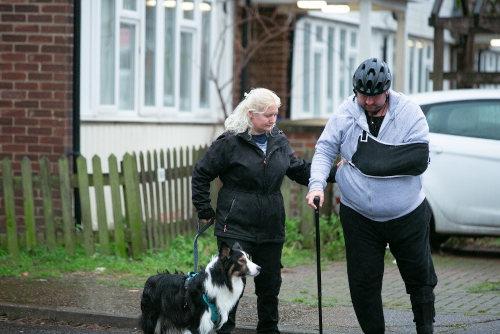
Walking is when I really feel the effect of my stroke the most. I can’t be on my phone and walk, as I can’t do two things at once very well.
Patrick, stroke survivor
Foot drop can improve with treatment but may be permanent in some cases.
We're here to support you on your path to recovery. Our support hub brings together all our online and in-person services, advice and guidance for stroke survivors and their families.

Physiotherapy can sometimes help foot drop, by giving you exercises to help with strengthening ankle and lower leg muscles. However, sometimes additional support for the ankle is needed.
An ankle-foot orthosis (AFO) is a type of brace that keeps your ankle and foot in one position, to reduce the risk of tripping or falling. It can help to improve your walking speed, stability and balance. Your AFO should be fitted by a qualified professional and you may be referred to an orthotist by a GP or physiotherapist. You’ll be assessed to check you can put on the AFO yourself or have help if you need it.
Functional electrical stimulation (FES) can be used to improve walking ability. It can help you walk more quickly, avoid falls and gain independence. It uses small electrical signals to directly stimulate the weak muscles to work. These electrical signals replace the nerve impulses that have been interrupted by damage to the brain. The electrodes can be applied to the skin to deliver electrical stimulation. Electrodes may be implanted directly onto the affected nerve, although this service is not widely available. Having FES on the skin can cause redness and can have an effect on spasticity, so it’s advisable to be assessed at a specialist FES centre after consulting with your therapists. Your doctor can refer you to a specialist FES centre or therapist for assessment and fitting, if it is a suitable treatment for you.
Preventing falls
Some people worry about having a fall after a stroke. You should be offered a falls risk assessment as part of your stroke rehabilitation. A physiotherapist can give you advice, or there may be a falls prevention service in your area. It can also help to remove trip hazards at home, like trailing wires and loose rugs, and to get some guidance on good lighting. See the NHS information on falls for more.
We have more tips and advice on avoiding falls.