
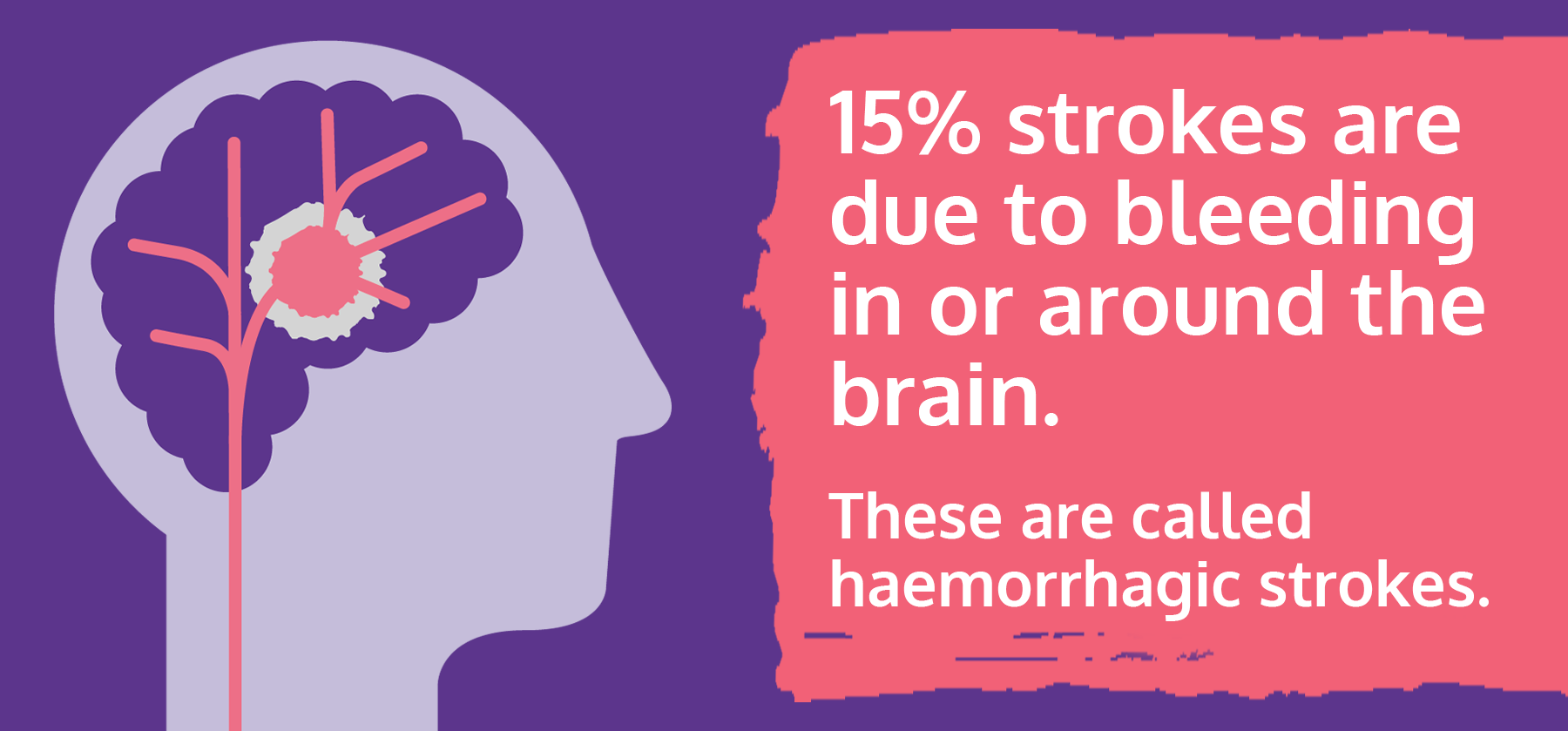
These pages are about strokes due to bleeding in or around the brain. You may also hear a haemorrhagic stroke referred to as a brain bleed or brain haemorrhage.
What is a haemorrhagic stroke?
Haemorrhagic stroke is when you have bleeding in or around the brain. This can damage brain cells. Damage to brain cells can affect how the body works. It can also change how you think, communicate and feel.
It’s less common than ischaemic stroke, which is due to a blocked artery (blood vessel). Around 15% of strokes in the UK are haemorrhagic.
If you have a haemorrhagic stroke, you will have a brain scan and emergency treatment. Afterwards, you will have support for your recovery, including medical prevention treatment and rehabilitation.
There are two main types of haemorrhagic stroke:
Bleeding within the brain (intracerebral haemorrhage or ICH)
Intracerebral haemorrhage (ICH) is where blood leaks out of a blood vessel into the brain tissue, sometimes deep inside the brain. ICH is the most common type of haemorrhagic stroke, and around two-thirds of all haemorrhagic strokes are ICH.
Bleeding on the surface of the brain (subarachnoid haemorrhage or SAH)
Subarachnoid haemorrhage (SAH) is where blood leaks out of a blood vessel on the surface of the brain and gets into the protective layer of fluid surrounding the brain. This layer is known as the subarachnoid space, and it helps to cushion the brain from injury. SAH is a less common type of stroke, causing about 5% of all strokes.
Symptoms of haemorrhagic stroke
Symptoms of a haemorrhagic stroke depend on where the bleed happens in the brain, but may include:
- Any of the signs of stroke in the FAST test – face weakness, arm weakness or speech problems.
- A sudden, severe headache, sometimes called a ‘thunderclap headache’. People describe it as the worst pain ever, like being hit on the head. It’s very likely with a subarachnoid haemorrhage (SAH) but can also happen with an intracerebral haemorrhage (ICH). Other common symptoms of SAH include a stiff neck, light sensitivity, nausea and vomiting.
- Weakness or numbness on one side of the body.
- Visual problems.
- Difficulties with speech or language.
- Seizures.
- Decrease in or loss of consciousness.



Resources
The information on this page can be accessed in the following formats:
- Download this information as a
- Order a printed copy from our shop.
- To request a braille copy, email feedback@stroke.org.uk